> ## Documentation Index
> Fetch the complete documentation index at: https://docs.altamiq.com/llms.txt
> Use this file to discover all available pages before exploring further.
# Partner Assets
> View, search, upload, and manage the marketing assets that belong to a single partner in AltamIQ, all from one focused per-partner view.
Partner Assets is the focused view of everything filed under one partner. Instead of scrolling the full marketing library, you see only that partner's materials grouped by where they came from, so you can quickly find a sales deck, a co-branded flyer, or a link to the partner's portal. This is the same panel that appears inside the Partner Profile Assets tab, so what you learn here works in both places.
This page always shows one partner at a time. Every asset here is tied to that partner. If you want to browse assets across all partners at once, use the main Marketing Assets library instead.
## How you get here
You always reach Partner Assets from a partner, never on its own.
Go to the Partner Directory and find the partner you want.
Click into the Partner Profile and choose the Assets tab, or use the partner's quick action to jump straight to their assets.
The view loads the assets that belong to that partner and nothing else. Switching from one partner to another refreshes the view so you never see the wrong partner's files.
 ## What you see
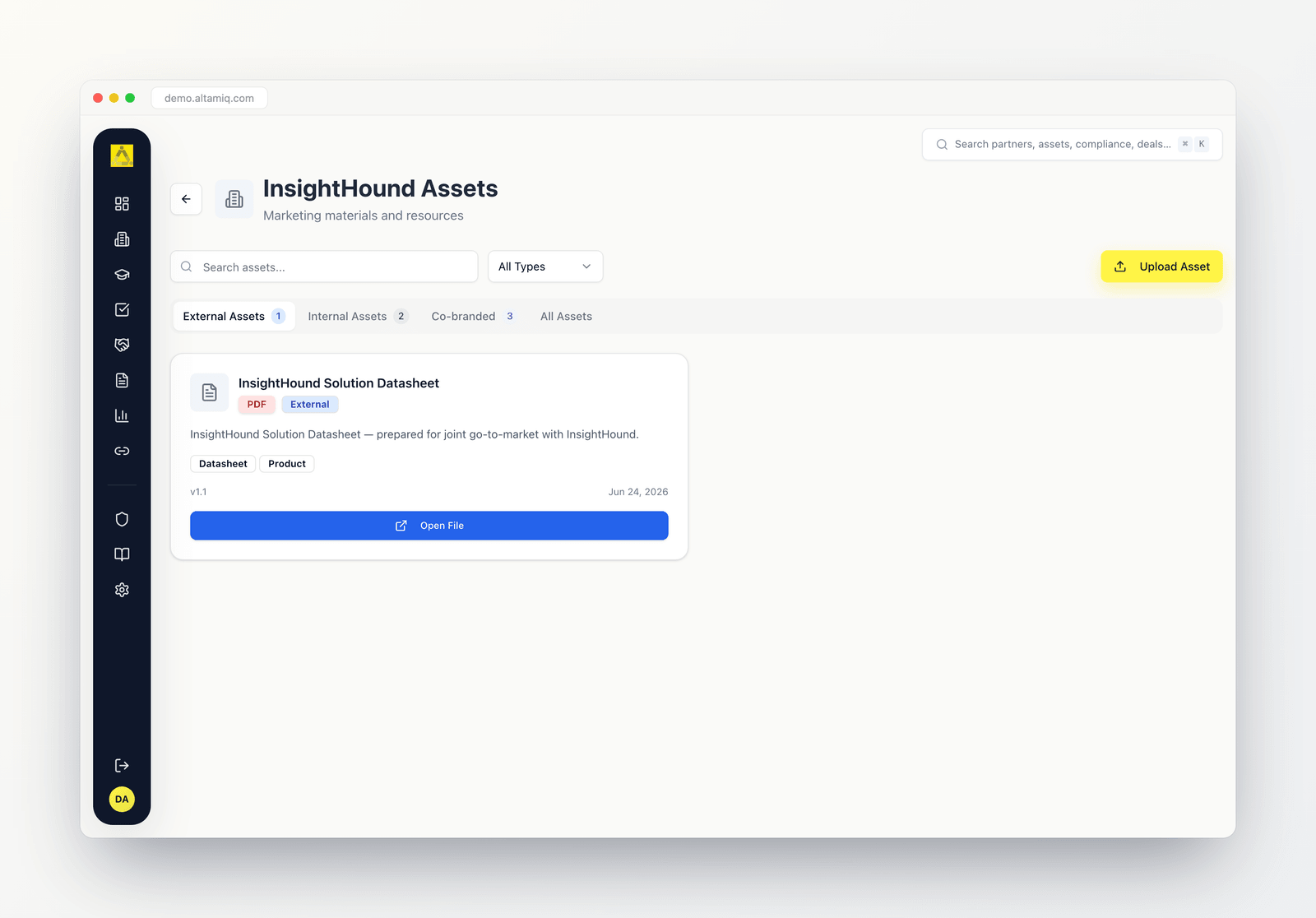
At the top of the view you get a search box and a file-type filter. Below them are source tabs, and under the active tab is a grid of asset cards.
### Source tabs
Assets are split by where they come from, and each tab shows a count so you know how many are in each group.
Materials the partner provided to you.
Materials your own company created for this partner.
Materials that carry both your brand and the partner's brand.
Everything for this partner in one combined list.
### Asset cards
Each card shows the asset title, a file-type badge (PDF, Video, Presentation, Image, Document, Template, or Link), a source badge, an optional description, any tags, the version, and the date it was added. If an asset has an expiration date that has passed, the card is dimmed and shows an "Expired on" note so you can tell it is out of date.
## Finding an asset
Start on External, Internal, Co-branded, or All Assets depending on what you are after.
Type in the search box to match against asset titles and descriptions.
Use the type dropdown to narrow to a single file type such as PDF or Video.
Search, the type filter, and the source tab all work together. If a list looks empty, widen your search or switch to the All Assets tab to confirm the asset is filed under a different source.
## Opening and downloading
To view an asset, click its title or the Open File button on the card. For a card menu, use the three-dot menu in the top corner. File-based assets offer both Download and View File. A Link asset opens the saved web address directly and shows Open Link instead of a Download option, which is handy for partner resources that live on a portal and cannot be downloaded.
## Uploading and editing assets
If your role allows it, you can add and update assets from this view.
Click Upload Asset. A form opens already tied to this partner, with the source pre-set to match the tab you were on.
Choose a file to upload, or switch the file type to Link and paste a web address for resources that cannot be downloaded. Uploaded files must stay under the size limit shown on the form, and the file type is detected for you.
Give the asset a title, then optionally set the source, version, campaign name, expiration date, description, and tags.
Save the asset. The grid refreshes so your new or updated asset shows right away.
When you edit an existing asset, the file is optional. Leave the file field empty to keep the current file, or choose a new one to replace it.
## How this relates to the Marketing Assets library
Partner Assets and the main Marketing Assets library show the same underlying materials, just filtered differently. Partner Assets narrows everything down to one partner and adds the External, Internal, and Co-branded source tabs. The Marketing Assets library is the wider view across all partners. Anything you upload here is tied to this partner and also appears in the library, so you do not have to add it twice.
## Who can do what
Full access. Search, open, download, upload, edit, and delete assets.
Can search, open, download, upload, and edit assets, but cannot delete them.
Read-only. Can search, open, and download assets, but cannot upload, edit, or delete.
Deleting an asset is limited to Admins. If you do not see Upload, Edit, or Delete options, your role does not include those permissions.
This documentation is built and hosted on [Mintlify](https://mintlify.com), a developer documentation platform.
## What you see
At the top of the view you get a search box and a file-type filter. Below them are source tabs, and under the active tab is a grid of asset cards.
### Source tabs
Assets are split by where they come from, and each tab shows a count so you know how many are in each group.
Materials the partner provided to you.
Materials your own company created for this partner.
Materials that carry both your brand and the partner's brand.
Everything for this partner in one combined list.
### Asset cards
Each card shows the asset title, a file-type badge (PDF, Video, Presentation, Image, Document, Template, or Link), a source badge, an optional description, any tags, the version, and the date it was added. If an asset has an expiration date that has passed, the card is dimmed and shows an "Expired on" note so you can tell it is out of date.
## Finding an asset
Start on External, Internal, Co-branded, or All Assets depending on what you are after.
Type in the search box to match against asset titles and descriptions.
Use the type dropdown to narrow to a single file type such as PDF or Video.
Search, the type filter, and the source tab all work together. If a list looks empty, widen your search or switch to the All Assets tab to confirm the asset is filed under a different source.
## Opening and downloading
To view an asset, click its title or the Open File button on the card. For a card menu, use the three-dot menu in the top corner. File-based assets offer both Download and View File. A Link asset opens the saved web address directly and shows Open Link instead of a Download option, which is handy for partner resources that live on a portal and cannot be downloaded.
## Uploading and editing assets
If your role allows it, you can add and update assets from this view.
Click Upload Asset. A form opens already tied to this partner, with the source pre-set to match the tab you were on.
Choose a file to upload, or switch the file type to Link and paste a web address for resources that cannot be downloaded. Uploaded files must stay under the size limit shown on the form, and the file type is detected for you.
Give the asset a title, then optionally set the source, version, campaign name, expiration date, description, and tags.
Save the asset. The grid refreshes so your new or updated asset shows right away.
When you edit an existing asset, the file is optional. Leave the file field empty to keep the current file, or choose a new one to replace it.
## How this relates to the Marketing Assets library
Partner Assets and the main Marketing Assets library show the same underlying materials, just filtered differently. Partner Assets narrows everything down to one partner and adds the External, Internal, and Co-branded source tabs. The Marketing Assets library is the wider view across all partners. Anything you upload here is tied to this partner and also appears in the library, so you do not have to add it twice.
## Who can do what
Full access. Search, open, download, upload, edit, and delete assets.
Can search, open, download, upload, and edit assets, but cannot delete them.
Read-only. Can search, open, and download assets, but cannot upload, edit, or delete.
Deleting an asset is limited to Admins. If you do not see Upload, Edit, or Delete options, your role does not include those permissions.
This documentation is built and hosted on [Mintlify](https://mintlify.com), a developer documentation platform.